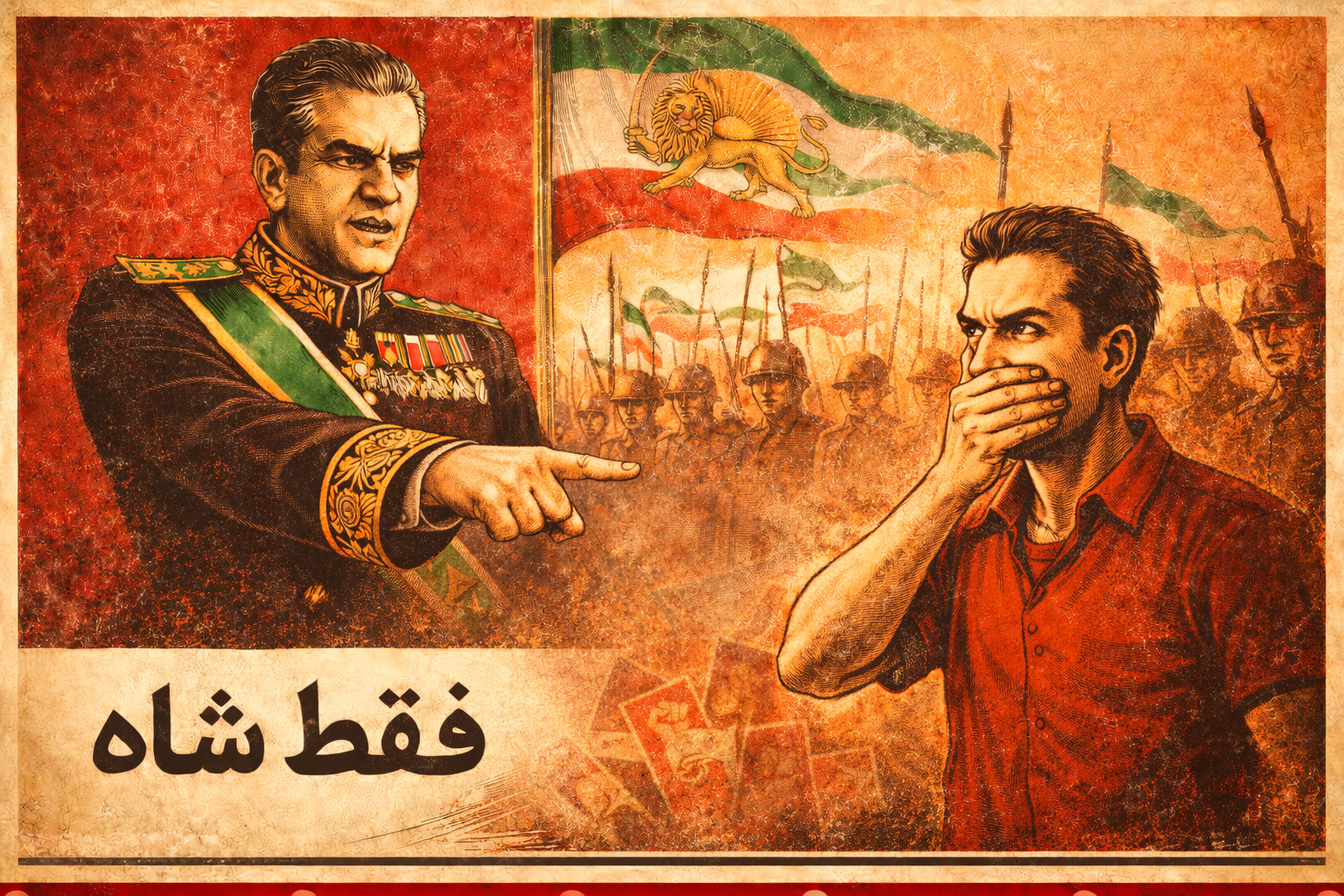
Introduction: Language Precedes Action
In 1947, Victor Klemperer, a German-Jewish philologist who survived the Nazi regime, published LTI: Lingua Tertii Imperii (The Language of the Third Reich). His meticulous documentation of how the Nazis corrupted German language remains one of the most important works on authoritarian rhetoric. Klemperer wrote:
"Words can be like tiny doses of arsenic: they are swallowed unnoticed, appear to have no effect, and then after a little time the toxic reaction sets in after all."
This insight—that authoritarian movements prepare the ground for violence through language long before they take power—forms the basis of this analysis. The conversation presented below, an exchange between a monarchist supporter and their critic, is not merely a political disagreement. It is a masterclass in manipulation tactics that scholars of fascist rhetoric would recognize immediately.
What makes this analysis different from documenting what Pahlavi supporters do (as examined in our previous article on Umberto Eco's framework) is that it focuses on what they say—the specific linguistic techniques used to shut down debate, delegitimize opposition, and manufacture consent. These are not random arguments; they form an interlocking system designed to make dissent impossible.
The Conversation
The following exchange took place online between a monarchist supporter (Speaker A) and a critic (Speaker B). It demonstrates ten distinct rhetorical manipulation tactics commonly found in fascist discourse.
Original Persian Text
الف: شما چه راه حلی دارید؟
ب: وقتی تا الان حتی ثابت نشده که رضا پهلوی قادر به مدیریت کلید مخزن شخصیش هست، صحبت از راه حل و دوران گذار ایران و ... زوده. اول یه چیزایی رو اثبات کن ما هم صحبت میکنیم.
الف: من مهندسی نگاه میکنم به موضوع. درباره کایزن مطالعه کن ببین چیه. نقطه شروعیه. بهتر از هیچیه. حرکت رو به جلویی هست
ب: این جماعت قاعدتاً نباید با یه کلید سازی که بعد از ۴ سال هم نتونسته یه قفل رو باز کنه بشینن صحبت از کشور کنن.
الف: حرکت بعدی رژیم بمب اتمیه. چشماتو بستی.
ب: همش دارم از چشم باز کردن صحبت میکنم. ولی خوب، این جمع از اون جمعهاییه که چشماشون رو باز نمیکنن.
الف: رضا پهلوی قطعا دوران گذار رو مدیریت خواهد کرد. تمرکز باید روی آزادی باشه، نه شخصیت محوری
ب: عجب. میگی شخصیت محوری نکنیم، بعد میگی قطعاً رضا پهلوی؟ این تناقض رو چطور حل میکنی؟
الف: مشکل جناح شما اینه که هم با مردم اختلاف دارین هم با خودتون. جناح من (تکنوکراتها و مریتخواهها) پشت منطقیترین نماینده جمع شدن
ب: جالبه که همیشه ادعا میکنین نماینده "مردم" هستین. کدوم مردم؟ اونایی که توی خیابونا کشته میشن، معلما، کارگرا، دانشجوها؟ یا اون مردمی که توی لس آنجلس هستن؟
الف: بعد از آزادی همه باید اون کشور رو بسازن صرف نظر از گرایش. ما هم دهه شصت عزیز از دست دادیم
ب: خوب پس چرا الان که هنوز آزادی نشده دارین "مرگ بر چپی" میگین؟ چرا الان که هنوز اپوزیسیون هستین دارین سر قبر نویسندهها میشاشین؟
الف: الان وقت کینهورزیهای تاریخیه؟ الان وقت اتحاده
ب: اتحاد که سوال کردن ازش کینهورزی نیست. اتحاد پشت کسی که چهل و هشت ساله هیچ کاری نکرده غیرممکنه.
الف: گمان میکنم شاید شما هم موافق این فجایع باشی؟
English Translation
A: What solution do you have?
B: When it hasn't even been proven that Reza Pahlavi is capable of managing his own personal vault key, it's too early to talk about solutions and Iran's transition period. First prove some things, then we'll talk.
A: I look at this from an engineering perspective. Read about Kaizen to see what it is. It's a starting point. Better than nothing. It's forward movement.
B: This group shouldn't be discussing the country with a locksmith who couldn't open a lock after 4 years.
A: The regime's next move is a nuclear bomb. You've closed your eyes.
B: I keep talking about opening eyes. But well, this is one of those groups that won't open their eyes.
A: Reza Pahlavi will clearly manage the transition period. Focus should be on freedom, not personality-centrism.
B: Interesting. You say don't focus on personality, then say "clearly Reza Pahlavi"? How do you resolve this contradiction?
A: Your faction's problem is you're at odds with both the people and yourselves. My faction (technocrats and meritocrats) gathered behind the most logical representative.
B: Interesting that you always claim to represent "the people." Which people? Those being killed in the streets, teachers, workers, students? Or the people in Los Angeles?
A: After freedom, everyone should build that country regardless of orientation. We also lost loved ones in the 60s [1980s Persian calendar].
B: Then why are you chanting "death to leftists" now, before freedom? Why are you urinating on writers' graves now, while still in opposition?
A: Is now the time for historical grudge-settling? Now is the time for unity.
B: Unity isn't threatened by asking questions. Unity behind someone who has done nothing for 48 years is impossible.
A: I suspect maybe you support these atrocities?
This brief exchange contains ten distinct rhetorical manipulation tactics. Let us examine each one.
Tactic #1: The "Solutions" False Dichotomy
The statement: "What solution do you have?" / "I look at this from an engineering perspective"
The opening gambit is deceptively simple. By demanding a "solution," the speaker frames political discourse as a technical problem that only qualified experts can solve. This is not a request for dialogue—it is a trap.
How This Tactic Works
The false dichotomy creates only two positions: either you have a complete alternative plan, or your criticism is invalid. This eliminates the legitimate role of critique, opposition, and deliberation in democratic politics. You don't need to be an architect to say a building is on fire.
This "engineering perspective" rhetoric has deep roots in fascist movements. Mussolini famously promoted himself as the technocrat who would make the trains run on time. The appeal is seductive: politics is messy, but engineering is clean. Problems have solutions. Experts know best.
As Hannah Arendt documented in The Origins of Totalitarianism, this technocratic framing serves to depoliticize inherently political questions. Who should lead? becomes a matter of efficiency, not values. How should we organize society? becomes an engineering problem with a correct answer—and anyone who disagrees simply doesn't understand the math.
The critic's response—pointing out that Pahlavi hasn't demonstrated basic competence—is dismissed not on its merits but because the critic hasn't offered an alternative "solution." This is classic deflection masquerading as rigor.
Tactic #2: Appropriating Progressive Language
The statement: "Read about Kaizen to see what it is. It's a starting point. Better than nothing."
Kaizen is a Japanese business philosophy of continuous improvement, popularized in Western corporate culture. Its invocation here is not accidental—it appropriates the language of progress, innovation, and forward-thinking to legitimize a political project.
How This Tactic Works
By borrowing terminology from business management, the speaker creates false equivalence between corporate efficiency and political organizing. The implicit message: supporting Pahlavi is simply common-sense improvement, like updating your software or streamlining a workflow.
Ruth Wodak, in her groundbreaking work The Politics of Fear, documented how right-wing movements systematically appropriate progressive terminology. Words like "freedom," "democracy," and "rights" are hollowed out and refilled with authoritarian content. Here, "Kaizen" performs similar work—it sounds modern, rational, and apolitical.
But political movements are not Toyota assembly lines. The question of who should lead Iran after the Islamic Republic involves competing values, historical grievances, and fundamental questions about power and accountability. Framing it as "continuous improvement" erases these contested dimensions.
The phrase "better than nothing" is particularly revealing. It pre-emptively lowers standards to the floor. Any criticism can be deflected: "Well, it's better than nothing." This rhetorical basement makes meaningful evaluation impossible.
Tactic #3: Catastrophizing to Foreclose Debate
The statement: "The regime's next move is a nuclear bomb. You've closed your eyes."
When the previous tactics fail to end the conversation, catastrophe enters. The threat is existential—nuclear annihilation—and it demands immediate action. There is no time for deliberation, critique, or alternative views. The house is on fire; stop asking questions and follow the leader.
How This Tactic Works
Catastrophizing creates artificial urgency that forecloses democratic deliberation. If the threat is imminent enough, any leader is preferable to debate. The German legal theorist Carl Schmitt called this the "state of exception"—the emergency that suspends normal politics.
This tactic has been central to authoritarian movements throughout history. "The Communists are at the gates" justified Hitler's emergency powers. "The revolution is in danger" justified Khomeini's consolidation. "Weapons of mass destruction" justified the Iraq War.
The accusation "You've closed your eyes" performs additional work. It reframes the critic not as someone with legitimate questions but as someone in denial—psychologically impaired, unable to see the obvious truth. Disagreement becomes pathology.
What makes this particularly insidious is that Iran's nuclear program is a genuine concern. But invoking it here serves not to address that concern but to shut down an unrelated conversation about Pahlavi's qualifications. The nuclear threat becomes a rhetorical weapon, not a policy discussion.
Tactic #4: Manufacturing Inevitability
The statement: "Reza Pahlavi will clearly manage the transition period."
Notice the word "clearly" (in Persian: قطعاً, meaning "certainly" or "definitely"). This single adverb performs enormous rhetorical work. It presents a contested political claim—that one specific individual will lead Iran's transition—as an established fact requiring no justification.
How This Tactic Works
Manufacturing inevitability marginalizes dissent by making it seem futile or delusional. If Pahlavi's leadership is "clear," then anyone who questions it isn't engaging in legitimate politics—they're simply failing to accept reality.
This echoes Margaret Thatcher's famous TINA doctrine: "There Is No Alternative." The phrase was designed not to describe reality but to create it—to make alternatives literally unthinkable. Here, the monarchist uses "clearly" to achieve the same effect.
The immediate follow-up—"Focus should be on freedom, not personality-centrism"—creates a fascinating contradiction that the critic immediately identifies. The speaker demands focus on principles over personalities while simultaneously insisting that one specific personality will "clearly" lead. This is not logical inconsistency; it is deliberate double-speak where the call for principle serves to smuggle in the personality cult.
Jason Stanley, in How Fascism Works, identifies this pattern as characteristic of fascist rhetoric: the constant invocation of abstract principles (freedom, democracy, the people) that serve in practice to justify rule by a specific leader. The principles are instrumental, not sincere.
Tactic #5: The "You're the Problem" Inversion
The statement: "Your faction's problem is you're at odds with both the people and yourselves."
This statement accomplishes multiple rhetorical tasks simultaneously. It projects divisiveness onto the critic, claims to speak for "the people," and pathologizes dissent as internal dysfunction.
How This Tactic Works
The inversion tactic shifts blame from the accused to the accuser. The movement that chants "death to leftists" and desecrates graves accuses its critics of being "at odds." The movement demanding loyalty to one leader accuses others of divisiveness.
The claim to represent "the people" is central to what Eco called "selective populism." In this framework, "the people" are not actual citizens with diverse views but a mystical unified entity whose will the leader interprets. Anyone who disagrees is, by definition, not part of "the people"—they are at odds with this imagined collective.
The accusation of being "at odds with yourselves" adds a psychological dimension. The critic is not merely wrong but internally conflicted, confused, perhaps mentally unstable. This pathologization of dissent—treating political disagreement as psychological disorder—has deep roots in authoritarian practice, from Soviet "sluggish schizophrenia" diagnoses to contemporary accusations that critics are "self-hating."
The critic's response is telling: "Which people? Those being killed in the streets, teachers, workers, students? Or the people in Los Angeles?" This punctures the mystification by asking a concrete question that "the people" rhetoric cannot answer.
Tactic #6: Self-Appointed Rationality
The statement: "My faction (technocrats and meritocrats) gathered behind the most logical representative."
Here the speaker explicitly claims exclusive access to reason. They are "technocrats and meritocrats"—rational, qualified, merit-based. Their choice of leader is "logical," implying that other choices are illogical. Disagreement is not a matter of different values or priorities but of failure to reason correctly.
How This Tactic Works
Self-appointed rationality delegitimizes opposition by framing political choice as mere logic. If supporting Pahlavi is the "logical" conclusion, then opponents are by definition illogical—driven by emotion, bias, or stupidity.
The historical resonance is troubling. Technocrats who claimed to be "above politics" served some of the twentieth century's worst regimes. Albert Speer presented himself as an apolitical architect serving efficiency; he was convicted at Nuremberg. The Vichy officials who administered Nazi-occupied France were heavily drawn from France's technocratic elite, who believed their expertise made them neutral instruments.
The danger of "meritocracy" rhetoric in authoritarian movements is that it replaces democratic accountability with claims of qualification. Who decides what counts as merit? Who certifies the technocrats? In practice, it is always the leader and their circle—making "meritocracy" a self-serving justification for existing power structures.
As Theodor Adorno documented in The Authoritarian Personality, this appeal to technical rationality while serving irrational political projects is characteristic of authoritarian movements. The surface is reason; the substance is submission.
Tactic #7: The False Unity Demand
The statement: "After freedom, everyone should build that country regardless of orientation. We also lost loved ones in the 60s [1980s]."
This statement makes a hollow promise of future inclusion while demanding current subordination. After freedom comes, we will all work together. But to get there, you must stop asking questions and follow now.
How This Tactic Works
The false unity demand creates a perpetual deferral of accountability. Questions about the leader's qualifications, the movement's tactics, or the treatment of critics are always premature—unity must come first. But "first" never arrives.
The invocation of shared loss—"We also lost loved ones in the 60s"—attempts to claim moral authority through suffering. The 1980s (1360s in the Persian calendar) saw mass executions of leftists and others by the Islamic Republic. By claiming this loss, the speaker positions themselves as equally victimized, despite the movement's current "death to leftists" rhetoric.
But this appropriation of shared trauma serves to silence rather than bridge. The critic cannot question the movement's hostility to leftists without seeming to dismiss monarchist suffering. The dead become rhetorical shields.
History shows what happens to "after the revolution" promises. Khomeini promised that after the Shah fell, Iran would be free, that all parties would participate, that he himself would retire to Qom. The "after" never came. Stalin promised that after the emergency of industrialization, the state would wither away. It never did. "After" is where accountability goes to die.
Tactic #8: The Accusation as Confession
The statement: "I suspect maybe you support these atrocities?"
This is the conversation's final move, and it is the most aggressive. Unable to answer the critic's questions about "death to leftists" chants and grave desecration, the speaker simply accuses the critic of supporting the Islamic Republic's atrocities.
How This Tactic Works
The accusation shifts the burden of proof to the accused. The critic must now defend themselves against an insinuation of supporting torture and murder, rather than continuing to ask uncomfortable questions about the monarchist movement's behavior.
This technique—transforming disagreement into complicity—has infamous historical precedents. McCarthyism operated on exactly this principle: if you questioned the anti-Communist crusade, you must be a Communist. If you criticized the methods of the House Un-American Activities Committee, you were aiding the enemy.
The rhetorical structure is: "If you criticize us, you must support them." This eliminates the space for principled opposition—for someone who opposes both the Islamic Republic and the monarchist movement's authoritarian tendencies. That space is precisely what this tactic is designed to destroy.
George Orwell identified this in "Politics and the English Language": the collapsing of complex positions into binary choices, the elimination of nuance, the transformation of thought itself into an act of choosing sides.
Tactic #9: Weaponizing Shared Trauma
The statement: "We also lost loved ones in the 60s [1980s]."
This statement deserves separate analysis beyond its role in Tactic #7. The invocation of loss—real, devastating loss from the 1988 massacres and other atrocities—is used here not to mourn or to build solidarity but to shut down critique.
How This Tactic Works
Weaponized trauma claims moral authority through suffering while using that authority to silence others who also suffered. It creates a hierarchy of grievability where some losses count and others don't—depending on current political alignment.
Judith Butler's work on grievability is relevant here. Some lives are publicly grieved, mourned, and memorialized; others are not. The monarchist movement's invocation of 1980s losses is selective—it claims the suffering of executed leftists and Mojahedin while the movement simultaneously chants for their deaths and desecrates their graves.
This is not mourning; it is appropriation. The dead are conscripted into a political project they might well have opposed. Their suffering becomes a resource to be deployed, not a memory to be honored.
The critic's response points directly at this contradiction: "Then why are you chanting 'death to leftists' now?" If the movement genuinely mourned the victims of the 1980s, it would not adopt the rhetoric of their executioners.
Tactic #10: The "Now Is Not the Time" Silencing
The statement: "Is now the time for historical grudge-settling? Now is the time for unity."
The final silencing tactic reframes legitimate questions as inappropriate timing. The critic isn't wrong; they're just untimely. Unity demands that we defer hard questions until... when exactly? After freedom? After transition? After Pahlavi is in power?
How This Tactic Works
The "not the time" tactic creates perpetual deferral of accountability. Questions about grave desecration become "grudge-settling." Concerns about eliminationist rhetoric become obstacles to "unity." The right time never arrives.
The framing of questions as "grudge-settling" (کینهورزی) is particularly insidious. It transforms legitimate political inquiry into petty personal vengeance. The critic isn't asking about documented patterns of behavior; they're nursing old grudges. They're the problem.
This tactic has been used to shield perpetrators in every post-conflict transition. "Now is not the time" protected Francoist officials in Spain's transition. "National reconciliation" protected apartheid beneficiaries in South Africa (until the Truth and Reconciliation Commission created space for accountability). "Looking forward, not backward" protected torturers in post-dictatorship Latin America.
The call for unity is not neutral. It is always a call to unify behind someone, on someone's terms. Here, it is a call to unify behind Pahlavi while deferring all questions about what that leadership would mean in practice.
The Cumulative Effect: How These Tactics Interlock
Examined individually, each tactic might seem like a common rhetorical move. But together, they form a closed system designed to make dissent impossible. Consider how they interlock:
- Tactic #1 (Solutions False Dichotomy) demands you have a complete alternative or stay silent
- Tactic #2 (Appropriating Progressive Language) frames the movement as rational and forward-thinking
- Tactic #3 (Catastrophizing) creates urgency that forecloses deliberation
- Tactic #4 (Manufacturing Inevitability) presents the leader's rule as already decided
- Tactic #5 (You're the Problem) turns criticism back on the critic
- Tactic #6 (Self-Appointed Rationality) claims exclusive access to reason
- Tactic #7 (False Unity Demand) promises future inclusion for current submission
- Tactic #8 (Accusation as Confession) makes disagreement complicity with atrocity
- Tactic #9 (Weaponized Trauma) claims moral authority while silencing victims
- Tactic #10 (Not the Time) defers all accountability indefinitely
No matter what position the critic takes, one of these tactics is ready to neutralize it. Have an alternative plan? (Tactic #6: it's not as logical as ours.) No alternative plan? (Tactic #1: then be silent.) Ask about past behavior? (Tactic #10: not the time.) Ask about current behavior? (Tactic #8: you must support the regime.) Cite specific concerns? (Tactic #5: you're the divisive one.) Express principled opposition? (Tactic #7: unity first, principles after.)
This is not debate; it is a rhetorical trap designed to ensure that only one conclusion is possible.
Historical Parallels: The Language Before the Violence
These tactics did not emerge in a vacuum. They recur across fascist movements because they work—they shut down opposition before it can organize.
Pre-1933 Germany
Klemperer documented how Nazi rhetoric used exactly these patterns: the false unity demand ("Ein Volk, ein Reich, ein Führer"), the manufactured inevitability ("The Thousand-Year Reich"), the accusation as confession ("If you oppose us, you support the Jews and Bolsheviks"), and the weaponized trauma (the "stab in the back" myth that blamed Germany's WWI defeat on internal enemies).
Pre-1979 Iran
Khomeini's revolutionary rhetoric employed the same toolkit: the false unity demand ("Neither East nor West"), the manufactured inevitability (the Islamic Republic as the culmination of history), the catastrophizing (the Shah as immediate existential threat requiring immediate action), and the accusation as confession (all opponents were tagged as "corrupt on earth" deserving death).
Contemporary Global Patterns
Ruth Wodak's research documents these tactics in contemporary right-wing populism across Europe and the Americas: the appropriation of progressive language ("freedom" meaning freedom from immigrants), the self-appointed rationality ("common sense" meaning xenophobia), the "not the time" silencing (questions about democratic norms are "divisive" during crises).
The tactics are not identical across contexts, but they share a family resemblance. They all serve to foreclose democratic deliberation and manufacture consent for authoritarian leadership.
The Difference Between Dialogue and Manipulation
It is worth contrasting this exchange with what genuine political dialogue looks like. In authentic debate:
- Questions are answered, not deflected
- Contradictions are addressed, not obscured
- Criticism is engaged, not pathologized
- Claims require evidence, not just assertion
- Accountability is immediate, not deferred
- Unity is built through agreement, not demanded as precondition
The exchange we analyzed exhibits none of these features. Every critic question is met not with an answer but with a counter-tactic designed to shut down the conversation. This is not dialogue; it is domination through language.
Recognizing the difference is the first step to resisting manipulation. When someone demands your solution before engaging your critique, that is Tactic #1. When someone invokes catastrophe to foreclose debate, that is Tactic #3. When someone calls for unity while attacking your right to question, that is Tactic #7. Name the tactic, and it loses some of its power.
Conclusion: Recognizing and Resisting Manipulation
Victor Klemperer survived the Nazi regime by paying attention to language. His meticulous documentation of how words changed meaning, how rhetoric prepared the ground for violence, how language itself became a tool of domination—this work remains essential because the tactics he documented remain in use.
The conversation analyzed in this article is not an isolated incident. It represents a pattern of discourse within the monarchist movement that scholars of fascist rhetoric would recognize immediately. The specific tactics may adapt to new contexts, but their function remains constant: to shut down dissent, manufacture consent, and prepare the ground for authoritarian rule.
"The sole purpose of the LTI was to strip everyone of their individuality, to paralyze them as personalities, to make them into unthinking and docile cattle in a herd driven and hounded in a particular direction, to turn them into atoms in a huge rolling block of stone."
— Victor Klemperer, LTI: The Language of the Third Reich
The antidote to manipulation is not counter-manipulation but clarity. Name the tactics. Insist on actual dialogue. Refuse the false choices. Demand that questions be answered rather than deflected. Build coalitions based on shared principles rather than submission to individuals.
Iran deserves an opposition that practices the democracy it claims to seek. That begins with language—with how we talk to each other, how we handle disagreement, how we build consensus. A movement that cannot tolerate questioning before it has power will not tolerate it after.
The language of silencing is a warning. We should heed it.
Summary: Ten Tactics of Fascist Manipulation
- The "Solutions" False Dichotomy: Demand alternatives to delegitimize criticism
- Appropriating Progressive Language: Hijack neutral/positive terms for political projects
- Catastrophizing: Create artificial urgency to foreclose debate
- Manufacturing Inevitability: Present contested claims as established facts
- The "You're the Problem" Inversion: Project divisiveness onto critics
- Self-Appointed Rationality: Claim exclusive access to reason
- The False Unity Demand: Promise future inclusion for current submission
- The Accusation as Confession: Transform disagreement into complicity
- Weaponizing Shared Trauma: Use suffering to silence rather than build solidarity
- The "Now Is Not the Time" Silencing: Defer all accountability indefinitely
Sources and Further Reading
- Victor Klemperer - "LTI: Lingua Tertii Imperii" (1947) — The foundational text on fascist language
- Hannah Arendt - "The Origins of Totalitarianism" (1951) — Analysis of technocratic authoritarianism
- Jason Stanley - "How Fascism Works" (2018) — Modern analysis of fascist rhetoric
- Ruth Wodak - "The Politics of Fear" (2015) — Right-wing populist discourse analysis
- George Orwell - "Politics and the English Language" (1946) — Classic essay on language and power
- Theodor Adorno - "The Authoritarian Personality" (1950) — Psychological analysis of authoritarian movements
- Umberto Eco - "Ur-Fascism" (1995) — Fourteen features of eternal fascism
- Judith Butler - "Frames of War: When Is Life Grievable?" (2009) — On whose suffering counts