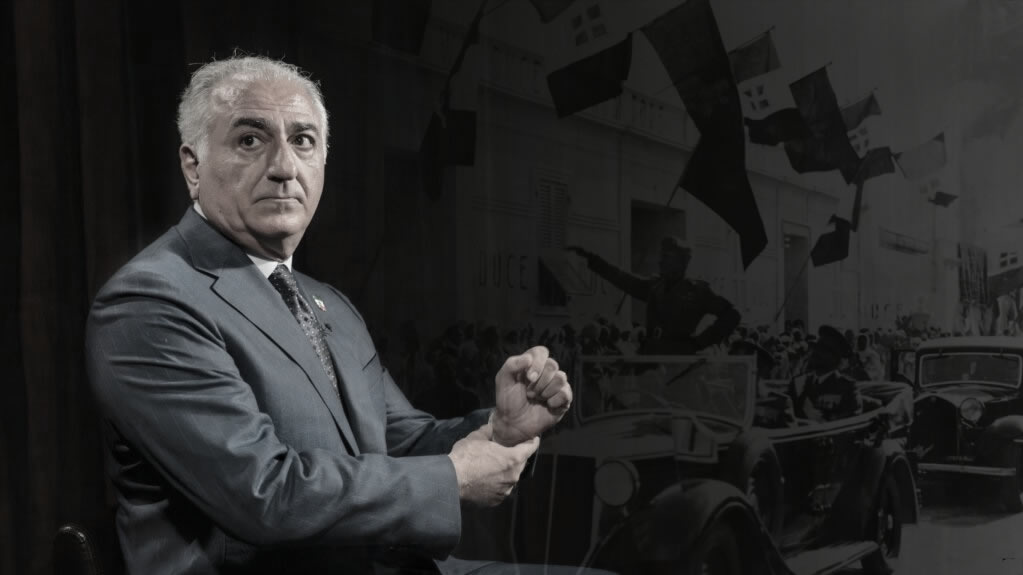
Introduction: When the Opposition Becomes the Oppressor
In the struggle for Iran's future, a troubling pattern has emerged among supporters of Reza Pahlavi that demands scholarly examination. While presenting themselves as advocates for democracy and freedom, a significant faction of Pahlavi supporters has adopted tactics that scholars of fascism would find disturbingly familiar: chanting death to political opponents, attacking Nobel Peace Prize laureates, desecrating graves of intellectuals, and demanding absolute loyalty to a single leader.
This is not mere political disagreement. As documented by researchers, journalists, and even conservative think tanks like the Middle East Forum and the American Enterprise Institute, the movement surrounding Reza Pahlavi has exhibited characteristics that align with classical definitions of fascism. Nobel laureate Narges Mohammadi has described this movement as becoming "the opposition against the opposition"—a force that attacks Iran's own democracy activists rather than uniting against the Islamic Republic.
This analysis applies Umberto Eco's influential academic framework on fascism to examine documented behaviors within the Pahlavi movement. The evidence suggests that before the Islamic Republic has even fallen, the seeds of a new totalitarianism are being planted.
The Academic Framework: Umberto Eco's Fourteen Features of Ur-Fascism
In 1995, the renowned Italian philosopher and novelist Umberto Eco published "Ur-Fascism" in The New York Review of Books. Having grown up under Mussolini's regime, Eco drew on personal experience and rigorous scholarship to identify fourteen characteristics of what he called "Eternal Fascism"—patterns that recur across fascist movements regardless of time or place.
Eco argued that fascism is a "fuzzy totalitarianism, a collage of different philosophical and political ideas, a beehive of contradictions." Unlike other totalitarian ideologies, fascism has no fixed doctrine—it adapts and mutates. Crucially, Eco noted that "it is enough that one of them [the fourteen features] be present to allow fascism to coagulate around it."
The behaviors documented within the Pahlavi movement align with multiple features from Eco's framework. This is not name-calling; it is rigorous analysis using established academic criteria.
"Death to Leftists and Mojahedin": The Elimination of Dissent
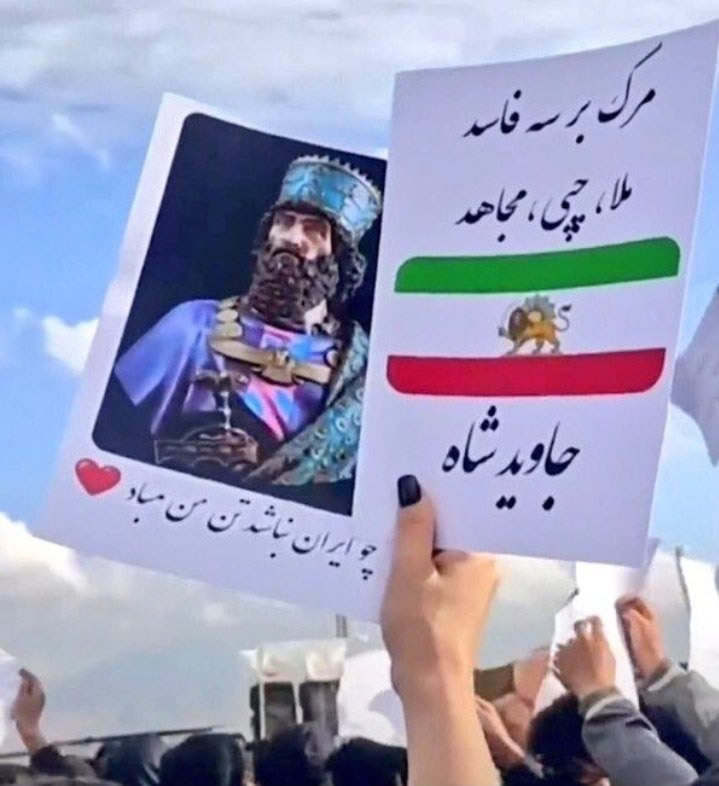
The "Death to Three Corrupt: Mullah, Leftist, Mojahed" slogan has been promoted in Pahlavi supporter circles
Among the most disturbing developments in the Pahlavi movement is the emergence of eliminationist rhetoric targeting not just the Islamic Republic, but also leftists and members of other opposition groups. The slogan "Death to three corrupt: mullah, leftist, mojahed" (in Persian: مرگ بر سه فاسد، ملا، چپی، مجاهد) has circulated among Pahlavi supporters.
In January 2023, Yasmine Pahlavi—Reza Pahlavi's wife—reposted this slogan on her Instagram story. The implications are staggering: while "death to mullahs" targets a political system, "death to leftists" targets millions of Iranians—trade unionists, social democrats, human rights activists, progressive intellectuals, and anyone who holds left-of-center political views.
Eco's Feature #4: "Disagreement is Treason"
Fascism "devalues intellectual discourse and critical reasoning as barriers to action." For Ur-Fascism, disagreement is betrayal. Critics are not merely wrong—they are enemies to be eliminated.
This slogan perfectly exemplifies Eco's fourth characteristic. In the logic of the Pahlavi movement's extremist wing, anyone who refuses to submit to the monarchist agenda—whether leftist, republican, reformist, or any other orientation—becomes an enemy equivalent to the Islamic Republic itself. The chant at some pro-Pahlavi rallies of "death to leftists" echoes the very eliminationist rhetoric that characterized European fascism of the 1930s.
Attacking Nobel Laureates: The Case of Narges Mohammadi
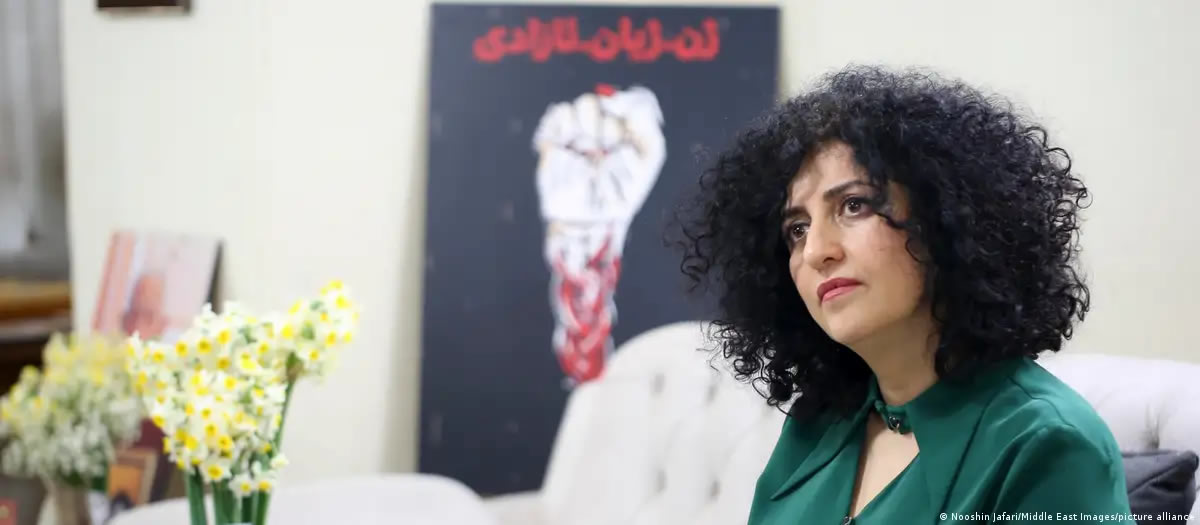
Narges Mohammadi, winner of the 2023 Nobel Peace Prize, has been labeled an "Islamic Republic project" by Pahlavi supporters
Narges Mohammadi has spent over a decade in Iranian prisons for her human rights activism. She has been tortured, separated from her children, and subjected to solitary confinement. In 2023, she was awarded the Nobel Peace Prize for her "fight against the oppression of women in Iran."
Yet rather than celebrating one of Iran's most prominent prisoners of conscience, elements of the Pahlavi movement have launched sustained attacks against her. According to Iran expert Alireza Nader: "Reza Pahlavi's extremist supporters have been attacking Nobel Peace Prize winner Narges Mohammadi since she was temporarily released from Evin prison for medical treatment (cancer). Extremist Pahlavists claim her release is 'suspicious.'"
The attacks on Mohammadi escalated when Yasmine Pahlavi, Reza Pahlavi's wife, questioned Mohammadi's credibility on Instagram, implying that her ability to communicate from prison meant she was "not a real political prisoner, but a puppet of the Islamic Republican government." Some monarchists went as far as condemning the Nobel Committee for awarding Mohammadi the prize.
Eco's Feature #7: "Obsession with a Plot"
Ur-Fascism is obsessed with conspiracy theories. "The followers must feel besieged... the easiest way to solve the plot is the appeal to xenophobia." Enemies are everywhere, and even apparent allies are secret agents of hostile forces.
The conspiracy theory that Iran's most famous political prisoner is secretly an agent of the regime she has spent her life opposing is precisely the kind of paranoid thinking Eco identified. In this worldview, anyone who does not fully embrace Pahlavi becomes suspect. A Nobel Peace Prize becomes evidence of conspiracy rather than recognition of sacrifice.
Targeting Taraneh Alidoosti: When Art Becomes Treason

Taraneh Alidoosti, star of the Oscar-winning film "The Salesman," has been attacked for her documentary about the Woman, Life, Freedom movement
Taraneh Alidoosti is Iran's most celebrated actress, best known internationally for starring in Asghar Farhadi's Oscar-winning film "The Salesman." During the Woman, Life, Freedom uprising in 2022, she publicly removed her hijab, supported protesters, and was subsequently arrested and imprisoned. After her release, she was diagnosed with DRESS Syndrome—a severe illness caused by drug interactions during her incarceration.
In December 2025, BBC Persian released "Taraneh: A Documentary", which documented her experiences during the uprising and her defiance of mandatory hijab laws. According to Radio Free Europe, the documentary has been praised internationally as "one of the most important visual documents of the Woman, Life, Freedom movement."
Yet elements of the monarchist movement have attacked Alidoosti as an "agent of the Islamic Republic." The logic is circular and unfalsifiable: if she is in prison, she might be a fake prisoner; if she makes art about the revolution, she might be manufacturing opposition for the regime. Any position she takes that does not explicitly endorse Reza Pahlavi becomes evidence of her collaboration with the enemy.
Eco's Feature #3: "The Cult of Action for Action's Sake"
"Action being beautiful in itself, it must be taken before, or without, any previous reflection. Thinking is a form of emasculation." Intellectuals and artists are inherently suspect because they reflect rather than act.
The attacks on Alidoosti—an artist whose weapon is culture rather than slogans—reflect the anti-intellectual current that runs through fascist movements. Her thoughtful documentary about women's resistance is deemed less valuable than unquestioning loyalty. Reflection becomes betrayal.
Desecrating the Grave of Gholam-Hossein Sa'edi
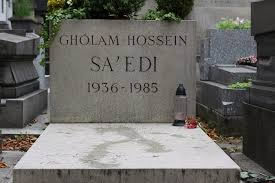
Père Lachaise Cemetery in Paris, where an Iranian monarchist urinated on the grave of writer Gholam-Hossein Sa'edi
Perhaps no single incident better captures the movement's descent into barbarism than the desecration of Gholam-Hossein Sa'edi's grave. Sa'edi, one of Iran's most influential writers and intellectuals, was a fierce opponent of the Shah's regime. He fled Iran after the 1979 revolution when the new Islamic government also targeted leftists, and died in exile in Paris in 1985. He is buried in the historic Père Lachaise Cemetery.
In late December 2024, a video went viral showing a monarchist draped in an Israeli flag urinating on Sa'edi's grave. As documented by Lefteast, this was not an isolated act of vandalism but "emblematic of a larger trend among certain factions of the Iranian opposition, particularly monarchists."
The symbolism was deliberate: the desecration targeted not just Sa'edi the individual but everything he represented—leftist politics, intellectual independence, and opposition to both the Shah and the Islamic Republic. The Israeli flag, draped over the perpetrator, added a geopolitical dimension, aligning the act with the monarchist movement's public embrace of Israel.
Eco's Feature #1: "The Cult of Tradition"
Ur-Fascism involves "a rejection of the Enlightenment, the Age of Reason." Combined with Feature #5 ("Fear of Difference"), this manifests as attacks on those who represent alternative intellectual traditions.
Sa'edi represented an Iran of writers, poets, and critical thinkers—an alternative tradition to monarchist nostalgia. By desecrating his grave, the perpetrator symbolically attacked not just a dead man but an entire intellectual heritage. The message was clear: in the new Iran these monarchists envision, there will be no room for Sa'edi or those who think like him.
Systematic Attacks on Writers and Intellectuals
The desecration of Sa'edi's grave represents the extreme end of a broader pattern. According to the Middle East Forum, Pahlavi's chief advisor Amir Etemadi "promotes the abuse of non-monarchist dissidents and journalists, labeling them as 'leftists,' 'separatists,' and 'terrorists' to encourage vitriol against them."
The Free Iran Scholars Network documents that many key Pahlavi advisers "brandish aggressive, chauvinistic, exclusionary and ultranationalist politics that could be classified as far-right. Some such supporters openly praise the SAVAK"—the Shah's notorious secret police responsible for torture and murder—"and reserve much of their ire not for the Islamic Republic but for its leftist and ex-reformist critics."
This hostility extends to academia. According to reports, "university professors and artists have withdrawn from social media platforms to protect their well-being, while journalists have altered their reporting style or modified their editorial guidelines to comply with pressure groups."
Eco's Feature #8: "Contempt for the Weak"
"Elitism is a typical aspect of any reactionary ideology... every citizen belongs to the best people of the world." Combined with anti-intellectualism, this produces contempt for those who exercise moral complexity rather than tribal loyalty.
The Iranian Writers' Association, labor organizers, religious intellectuals, and former regime critics who have paid dearly for opposing the Islamic Republic now find themselves targeted by monarchists. Those who should be natural allies in the struggle for democracy are instead treated as enemies for refusing to submit to Pahlavi's leadership.
"Subordinate or Be Silent": The Demand for Absolute Loyalty
The Georgetown Summit Front of 2023—an attempt to unite diverse Iranian opposition figures—collapsed when "Pahlavi withdrew from collaboration and declared that his role is above all others." This incident encapsulates a fundamental problem: the movement demands loyalty to Pahlavi personally, not to democratic principles.
When opposition figures published a unity charter, Pahlavi's supporters were among those who led the attack. Their criticisms were "vague or even conspiratorial," questioning why the charter used a clenched fist logo and asking if this revealed "a hidden leftist agenda." The real objection was to "the very fact of him allying with left-leaning figures."
At the July 2025 Munich Convergence Summit, Pahlavi was designated "Leader of the National Uprising." As critics have noted, this creates a structure where "by constantly appealing to 'the will of the people' without defining or organizing it, Pahlavi creates the illusion of democratic principle while maintaining personal ambiguity."
Eco's Feature #9: "Selective Populism"
"For Ur-Fascism... individuals as individuals have no rights, and the People is conceived as a quality, a monolithic entity expressing the Common Will... the Leader pretends to be their interpreter."
The formula is classic fascist populism: "the people" (imagined as a unified whole) have chosen Pahlavi as their leader. Anyone who disagrees is, by definition, not truly part of "the people." Dissent is not legitimate political difference—it is betrayal of the national will that Pahlavi claims to embody.
The Troll Army: Organized Harassment and Intimidation
The abuse directed at Pahlavi's critics is not spontaneous—it shows signs of coordination. According to research documented by Free Iran Scholars Network, significant bot and troll activity supports the monarchist movement online.
A 2023 investigation by data analytics firm Social Forensics found that "monarchists" were the "most influential community" of weaponized accounts targeting Iran. The firm identified networks of inauthentic accounts, many using AI-generated profile photos, that "activated in early 2024" after being created in 2023 but remaining dormant—"which points to planned coordination."
Strikingly, the analysis found that "one out of every eight accounts followed by @IsraelPersian [an official Israeli government account] were inauthentic monarchist accounts." Pro-Pahlavi accounts, some revealed by X to be operating from Iran, "amplify Pahlavi's popularity while creating a toxic social media environment through harassment of non-monarchists."
Victims include Iranian activist Hamed Esmaeilion, who organized major anti-regime protests in Berlin during the Woman, Life, Freedom uprising; rapper Toomaj Salehi; journalist Masih Alinejad; and countless academics, journalists, and ordinary Iranians who voice criticism.
Eco's Feature #14: "Ur-Fascism speaks Newspeak"
"All the Nazi or Fascist schoolbooks made use of an impoverished vocabulary, and an elementary syntax, in order to limit the instruments for complex and critical reasoning."
The online discourse promoted by these networks is characterized by simple, repetitive slogans rather than nuanced argument. Critics are "leftists," "terrorists," "separatists," or "regime agents"—labels designed to shut down debate rather than engage with it. This impoverished vocabulary is precisely what Eco identified as characteristic of fascist communication.
The Totalitarian Playbook Before Seizing Power
What makes these patterns especially alarming is that they are emerging before any transition of power. The Islamic Republic still rules Iran. Pahlavi has never held office. Yet already his movement exhibits:
- Eliminationist rhetoric against entire categories of Iranians (leftists, mojahedin)
- Conspiracy theories about Nobel laureates and prominent dissidents
- Attacks on artists and intellectuals for insufficient loyalty
- Desecration of graves of those who represent alternative traditions
- Demands for absolute loyalty to the leader personally
- Coordinated harassment campaigns against critics
- Celebration of SAVAK, the Shah's torture apparatus
As Jacobin documented, the monarchist movement's "internal culture is one of paranoia, misogyny, and authoritarianism, with supporters resorting to rape and death threats against anyone, including journalists and scholars, with whom they disagree."
If this is how the movement behaves as an opposition group—when it has no actual power—what would it do with control of the state?
The Warning Signs of Ur-Fascism
Umberto Eco, reflecting on his childhood under Mussolini, offered this warning: "Ur-Fascism is still around us, sometimes in plainclothes. It would be so much easier, for us, if there appeared on the world scene somebody saying, 'I want to reopen Auschwitz'... Ur-Fascism can come back under the most innocent of disguises."
The Pahlavi movement does not march in brownshirts. It speaks of democracy and referendums. But when a movement chants death to its political opponents, attacks Nobel laureates, desecrates graves, celebrates secret police, and demands subordination to a single leader—the disguise is wearing thin.
Of Eco's fourteen features of Ur-Fascism, the Pahlavi movement's documented behaviors align with at least eight:
- Cult of Tradition — Monarchist nostalgia, rejection of republican and leftist intellectual traditions
- Rejection of Modernism — Hostility to progressive political thought
- Cult of Action — Anti-intellectualism, suspicion of artists and writers
- Disagreement is Treason — Treating all critics as regime agents
- Fear of Difference — Eliminationist rhetoric against leftists and other groups
- Obsession with a Plot — Conspiracy theories about Nobel laureates and dissidents
- Selective Populism — The leader as interpreter of "the people's will"
- Newspeak — Impoverished vocabulary of labels and slogans
Eco wrote that "it is enough that one of them be present to allow fascism to coagulate around it." Eight is a pattern.
Conclusion: The Opposition Against the Opposition
Iran's struggle for freedom deserves an opposition movement that upholds the democratic values it claims to fight for. Instead, significant elements of the Pahlavi movement have adopted the tactics of the very system they claim to oppose: elimination of dissent, conspiracy theories, attacks on intellectuals, demands for absolute loyalty, and organized harassment of critics.
Narges Mohammadi's description of the movement as "the opposition against the opposition" is painfully accurate. Rather than building a coalition against the Islamic Republic, the monarchist movement attacks labor organizers, writers' associations, human rights activists, and anyone who refuses to subordinate themselves to Reza Pahlavi.
This is not about left versus right, or about policy disagreements. It is about whether Iran's opposition can build a genuinely democratic alternative or whether it will replace one form of authoritarianism with another. The evidence presented in this analysis—drawn from conservative think tanks, mainstream media, and academic research—suggests that the Pahlavi movement, at least in its current form, represents not the promise of democracy but the threat of Ur-Fascism.
Iranians have suffered for decades under the Islamic Republic. They deserve better than to exchange one set of executioners for another. They deserve an opposition that practices the democracy it preaches—not one that has already begun the purges before it has even taken power.
Sources
- Umberto Eco - "Ur-Fascism" (The New York Review of Books, 1995)
- Wikipedia - Ur-Fascism
- Middle East Forum - Has Reza Pahlavi Become the Opposition to Iran's Opposition?
- American Enterprise Institute - Reza Pahlavi Must Leave His Trolls Behind
- TIME - Iranians Are Protesting. Reza Pahlavi Can't Save Them
- Lefteast - Sa'edi's Legacy, Monarchist Desecration, and the Israeli Flag
- Al Jazeera - Why Are Iranian Monarchists Backing Israel?
- Alireza Nader on X - Attacks on Narges Mohammadi
- Free Iran Scholars Network - Behind the Crown
- Free Iran Scholars Network - The Mirage of Online Monarchy
- Kit Klarenberg - Israel's Secret Social Media War On Iran
- Jacobin - The Failson and the Flag
- New Lines Magazine - The Fiasco of Iranian Diaspora Politics
- RFE/RL - Taraneh Alidoosti Documentary
- Balatarin - Yasmine Pahlavi slogan controversy